Forever Young Song Meaning: Alphaville, Bob Dylan and Rod Stewart Explained
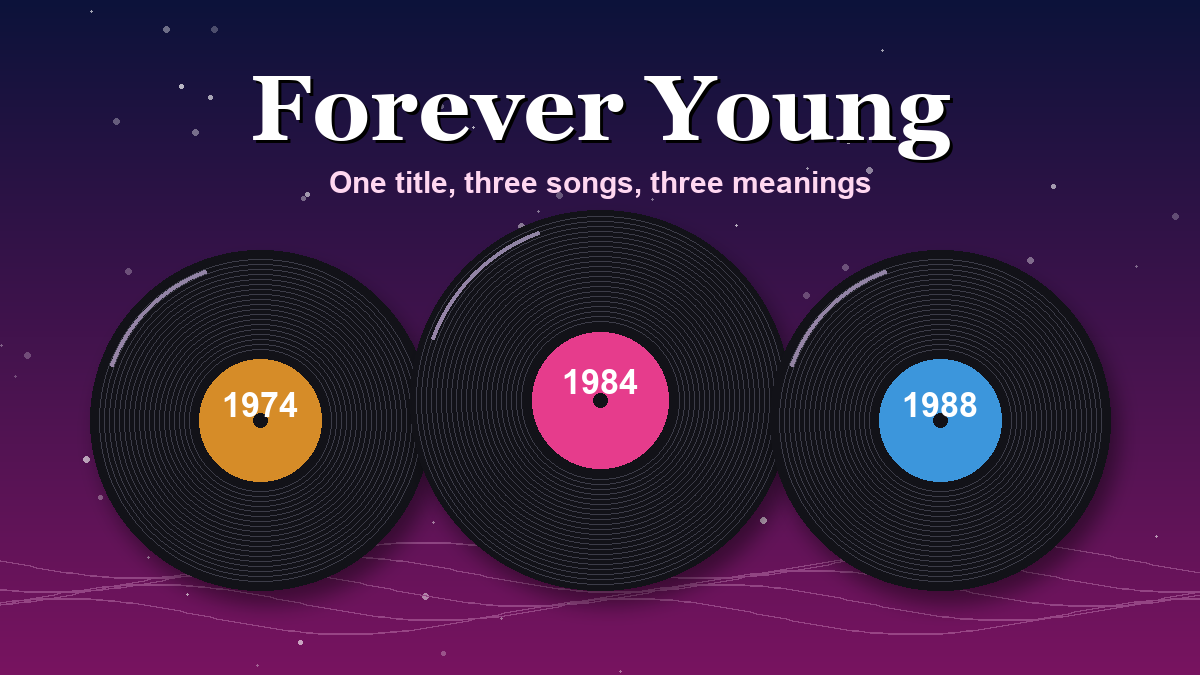
Short answer: "Forever Young" is not one song but at least three famous ones with the same title, and they mean different things. Alphaville's 1984 synth-pop hit is a Cold War song about wanting to stay young in a world that might end at any moment. Bob Dylan's 1974 song is a parent's blessing for a child. Rod Stewart's 1988 hit is a father's wish list for his children that came so close to Dylan's idea that the two men agreed to share it. Then Jay-Z's 2009 "Young Forever" turned Alphaville's chorus into a hip-hop anthem. Here is what each one is really about, and how to tell which "Forever Young" is stuck in your head.
Which "Forever Young" are you thinking of?
- Slow synth-pop with a dreamy, echoing chorus → Alphaville (1984), music by Marian Gold, Bernhard Lloyd and Frank Mertens, lyrics by Marian Gold.
- Folk-rock that sounds like a prayer for a child → Bob Dylan (1974), from the album Planet Waves.
- Upbeat late-80s soft rock with a sing-along chorus → Rod Stewart (1988), from Out of Order.
- Rap verses over the Alphaville melody → Jay-Z featuring Mr Hudson, "Young Forever" (2009), produced by Kanye West.
Alphaville, "Forever Young" (1984): youth under the shadow of the bomb
Alphaville formed in Münster, West Germany, in 1982. Before they took their name from Jean-Luc Godard's 1965 science-fiction film Alphaville, the trio actually called themselves Forever Young. The song of that name came out in September 1984 as the third single from their debut album, also called Forever Young.
It sounds like a slow-dance ballad, and that is how many people still hear it at proms and weddings. The verses tell a darker story. The song is set in a world waiting for the end — at one point the singer simply asks whether the bomb is going to be dropped or not — and its best-known line, "Let us die young or let us live forever" (Marian Gold, Alphaville), is less a celebration of youth than a shrug at a future that may never arrive. In 1984 new American and Soviet nuclear missiles were being deployed in Europe, and for a band from a divided Germany that fear was not abstract.
So the meaning sits in the tension between two wishes: stay young forever, because youth is when you feel most alive, or burn out young before the grown-up world wrecks everything. The song never resolves it, which is a big part of why it still speaks to teenagers four decades later.
Three details from the recording make the story richer:
- It was meant to be a dance track. After two days of unsatisfying sessions, producer Andreas Budde had the band strip it back to vocals and synth pads. That sparse version is the one the world knows.
- The third verse was censored, in a way. Gold's original draft described a crowd blindly adoring a leader. Record executives pushed for a softer line, and Gold has since called the replacement the worst lyric in the song.
- It was a slow-burn hit. It charted first in Scandinavia and German-speaking Europe; in the US it only reached No. 93 on the Billboard Hot 100 in 1985 and No. 63 on a 1988 re-entry. Films, covers and radio did the rest, and it has passed 1.2 billion Spotify streams.
Bob Dylan, "Forever Young" (1974): a blessing from a parent
Dylan's song is ten years older and comes from a completely different place. He recorded it in California in November 1973 with The Band, and it appeared on Planet Waves in January 1974 in two versions: a slow lullaby and a faster, rockier take. In the notes to his 1985 box set Biograph, Dylan said he wrote it in Tucson, Arizona, "thinking about" one of his sons and "not wanting to be too sentimental" — which is one explanation for why he kept both versions. Accounts differ on which son he meant; some point to his eldest, Jesse, others to Jakob, born in 1969.
The meaning is simple, and that is its strength. Every verse is a wish a parent makes for a child: be honest, be brave, be useful to others, and keep a young heart however old the body gets. The opening line, "May God bless and keep you always" (Bob Dylan), echoes the ancient priestly blessing in the Book of Numbers, so the song feels more like a prayer than a pop lyric. "Forever young" here does not mean never ageing. It means staying open, joyful and principled for a whole life.
That is why Dylan's version turns up at graduations, naming ceremonies and farewells. Sportscaster Howard Cosell recited it on American television when Muhammad Ali won the heavyweight title for the third time, and Dylan and The Band played it at The Band's 1976 farewell concert, filmed by Martin Scorsese as The Last Waltz.
Rod Stewart, "Forever Young" (1988): a father catching up
Rod Stewart wrote his "Forever Young" with guitarist Jim Cregan and keyboardist Kevin Savigar for the 1988 album Out of Order. It became one of his strongest late-80s singles in North America, peaking at No. 12 on the Billboard Hot 100 and No. 9 in Canada, though it barely dented the UK chart.
Stewart told Mojo magazine in 1995 that it was "a real heartfelt song about my kids", written after he realised he had missed years of his older children's lives while touring. Like Dylan's song, each verse is a hope for a child: stay true, stand your ground, know you are loved. The music video shows Stewart singing to a young boy as rural America rolls past.
The likeness to Dylan's song was close enough that, once it was finished, the song was sent to Dylan to ask whether he had a problem with it. The two agreed to share ownership and Stewart's royalties, and Dylan is now credited as a co-writer. Stewart's manager summed it up at the time: the melody and the music were different, but the idea was the same.
Jay-Z and Mr Hudson, "Young Forever" (2009): Alphaville goes hip-hop
Alphaville's song reached a new generation through Jay-Z. "Young Forever", from The Blueprint 3 and released as a single in early 2010, keeps the original melody. British singer Mr Hudson sings Alphaville's words in the first verse and chorus, and Jay-Z raps new verses in place of the rest. Kanye West produced it, and Gold, Lloyd and Mertens share the writing credit.
The meaning shifts again. Jay-Z drops the nuclear dread and keeps the core wish: live so fully that the moment feels permanent. The single reached No. 10 on both the Billboard Hot 100 and the UK chart, and Jay-Z and Beyoncé later used it as the encore of their On the Run tours. For many listeners under 30, this is the first "Forever Young" they ever heard. If you want the bigger picture of how rap reworks older songs, our look at how hip-hop lyrics evolved is a good next read.
Why songwriters keep coming back to this title
"Forever young" holds two opposite feelings in two words: hope and loss. A parent singing it hopes the best parts of childhood survive adulthood. A young person singing it fears that growing up means losing something. Alphaville leans on the fear, Dylan and Stewart lean on the hope, and Jay-Z turns it into a celebration. Each new version also borrows emotional weight from the one before, the way a famous cover can change how we hear an original — compare what Johnny Cash did with "Hurt". And like "Bohemian Rhapsody", Alphaville's song is a reminder that a gentle melody can carry a very dark lyric.
The four songs at a glance
- Bob Dylan (1974) — folk-rock, Planet Waves; a parent's blessing to a child.
- Alphaville (1984) — synth-pop, Forever Young; staying young in a world that might end.
- Rod Stewart (1988) — soft rock, Out of Order; a father's hopes for his kids, co-credited to Dylan.
- Jay-Z feat. Mr Hudson (2009) — hip-hop, The Blueprint 3; Alphaville's chorus as a live-for-the-moment anthem.
Looking for more songs that have outlived their decade? See our list of the best pop songs of all time.
FAQ
Is "Forever Young" a sad song?
Alphaville's is bittersweet: the music is gentle, but the verses are shaped by fear of nuclear war. Dylan's and Rod Stewart's songs are hopeful messages from a parent to a child.
Who sang "Forever Young" first?
Bob Dylan, in 1974. Alphaville's 1984 song is a different composition that shares the title, and Rod Stewart's 1988 song shares its songwriting credit with Dylan.
Is "Forever Young" a good song for a graduation or wedding?
Dylan's and Stewart's versions are written as blessings, so they suit graduations, birthdays and farewells. Alphaville's works as a slow dance, but it is worth knowing what the verses are about before you pick it.
Where can I read the full lyrics?
Lyriccs does not reproduce copyrighted lyrics. Use a licensed lyrics service or the artists' official channels, such as Bob Dylan's official site.
Sources
- "Forever Young" (Alphaville song) and Alphaville (band), Wikipedia
- "Forever Young" (Bob Dylan song), Wikipedia; bobdylan.com
- "Forever Young" (Rod Stewart song), Wikipedia
- "Young Forever", Wikipedia